Athletic facilities specify ventilated locker doors because sports equipment, uniforms, and shoes hold moisture that must dry between uses to limit odor, mildew, and bacteria growth on stored items. Ventilation turns a closed metal box into a compartment where air can circulate.
Staph infections, including MRSA, have been linked to athletic settings where skin contact and shared equipment are common (Centers for Disease Control and Prevention).
What moisture problems do athletic lockers face?
Athletic lockers face moisture problems from sweat-soaked uniforms, wet towels, damp pads, and shoes that are stored immediately after practices and games. Unlike office lockers, athletic lockers often hold gear that is still wet when the door closes.
Extended storage during a season
Team rooms may also store equipment for days at a time during a season. That extended storage magnifies the effect of trapped humidity. Coaches and athletic directors frequently cite odor as one of the most persistent complaints about locker rooms, and much of that odor originates in gear that never fully dried.
How do ventilated doors improve airflow?
Ventilated doors improve airflow by allowing room air to pass into and out of the locker compartment through openings in the door face. The openings reduce the difference in humidity between the inside of the locker and the room.
Common ventilated door designs
- Louvered doors with angled slots near the top and bottom
- Diamond-perforated doors with openings across the full face
- Expanded metal or mesh doors for maximum air exchange
- Lattice-style plastic doors for wet areas
- Open-front team lockers without doors
Each design balances ventilation against privacy and security. Louvers offer modest airflow with high privacy, while mesh and lattice designs offer high airflow with more visibility into the compartment.
Which collections pair airflow with visibility
Ventilation-focused collections pair airflow with visibility for team rooms, and one steel line is designed to combine ventilation and visibility with strength and visual appeal (ASI Storage Solutions).
Why is visibility sometimes an advantage?
Visibility is sometimes an advantage because coaches, equipment managers, and facility staff can see at a glance whether lockers are clean, whether gear is stored properly, and whether items have been left behind. Visibility also discourages storage of prohibited items.
Visibility in team rooms
Team locker rooms for school and collegiate athletics often favor high-visibility designs. The combination of airflow and visibility supports both hygiene and accountability.
How does locker material interact with ventilation?
Locker material interacts with ventilation because some materials resist moisture better than others when damp air reaches internal surfaces. Ventilation helps gear dry, but the locker itself still experiences humid conditions.
Material considerations for athletic lockers
- Powder-coated steel is strong and economical, and performs best with good room ventilation
- Solid plastic resists rust and corrosion in persistently wet rooms
- Phenolic resists moisture and impact and offers a premium appearance
Heavy-gauge steel lockers with welded construction suit high-abuse environments like high school and collegiate team rooms. Plastic lockers suit aquatic centers and rooms adjacent to showers.
What role does room ventilation play?
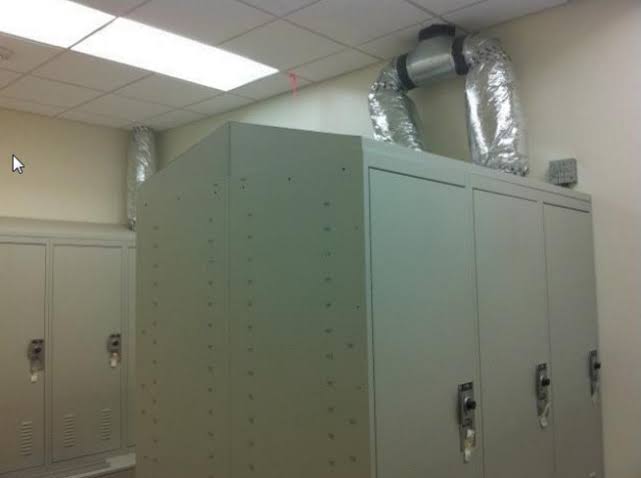
Room ventilation plays a critical role because ventilated lockers depend on drier room air to pull moisture out of stored gear. A humid room limits how much benefit a ventilated door can provide.
Ventilation and healthy indoor air
Ventilation and moisture control are central to healthy indoor air (U.S. Environmental Protection Agency). In athletic facilities, adequate exhaust near shower and locker areas helps the entire room dry faster between uses.
How should facilities manage gear hygiene?
Facilities should manage gear hygiene by combining ventilated lockers with operational practices that encourage athletes to launder uniforms, air out pads, and remove wet items daily. Equipment design and team habits work together.
Practical hygiene practices
- Require uniforms and towels to be laundered after each use
- Provide drying racks or hooks for pads and helmets
- Clean locker interiors on a regular schedule
- Keep floors dry and drains clear around locker banks
- Encourage athletes to avoid sharing towels or personal items
Moisture control is the primary way to prevent mold growth indoors (U.S. Environmental Protection Agency). Drier gear, drier lockers, and drier rooms all contribute.
What durability features matter in athletic lockers?
Durability features that matter in athletic lockers include heavy-gauge doors and frames, reinforced hinges, strong latching, and resistant finishes. Athletic lockers face slamming doors, kicks, and heavy loads more often than lockers in offices, schools, or breakrooms.
Durability features to look for
- Welded frame construction for rigidity
- Full-length or multi-knuckle hinges
- Recessed handles to reduce impact damage
- Sloped tops to discourage storage on top of lockers
- Bases or legs that simplify floor cleaning
How do athletic locker layouts support team operations?
Athletic locker layouts support team operations by grouping lockers by team or position, providing room for benches and gear carts, and keeping clear paths to showers, restrooms, and exits. A well-planned room reduces congestion before and after practices.
Layout features that help team rooms function
- Wide aisles for players carrying equipment
- Benches placed in front of locker banks
- Hooks or racks for helmets and pads
- Clear routes to training and shower areas
Coaches often want a team meeting area inside the locker room, which affects how locker banks are arranged. Planning that space early prevents cramped layouts that slow down pregame routines.
Why is ventilation a long-term investment for athletic programs?
Ventilation is a long-term investment for athletic programs because it protects gear, reduces odor complaints, and extends the useful life of both lockers and equipment. Athletic programs spend significant budgets on uniforms and protective gear, and storage conditions affect how long that gear lasts. Specifying ventilated doors, pairing them with the right material, and supporting them with good room ventilation gives athletic facilities storage that performs under the toughest daily conditions.